
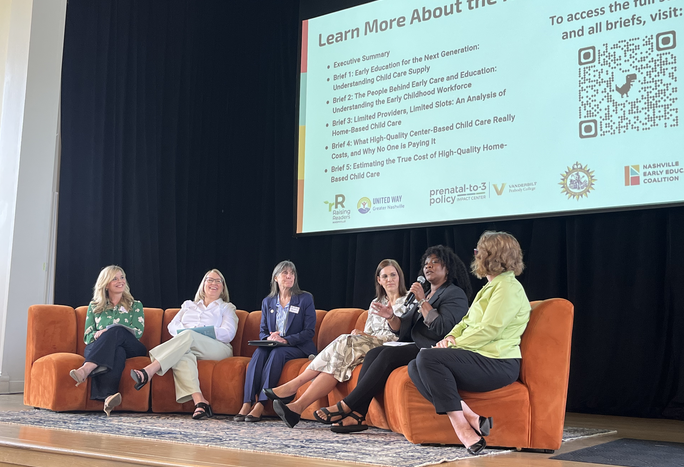
New survey finds infant care could consume up to 80% of a single parent’s income if priced at the true cost of high-quality child care.
A recent study of Davidson County child care providers reveals a stark reality for working families: the estimated true cost of high-quality child care far exceeds what most parents can afford.
Local child care data shows that if child care tuition was priced at the estimated true cost of providing high-quality child care, a single parent household in Davidson County would need to spend nearly 80% of their monthly income to afford infant care at a high-quality early childhood education center. Even in a two-parent household earning the county median income, infant care consumes more than 40% of monthly earnings—placing quality care out of reach for many families.
The research was conducted by Vanderbilt University’s Prenatal-to-3 Policy Impact Center, in partnership with Raising Readers Nashville, powered by United Way of Greater Nashville (UWGN), and the Nashville Early Education Coalition. The survey represents Phase II of the Davidson County Child Care Landscape Study, a multi-year effort to understand and address Nashville’s growing child care crisis.
Survey responses were collected from approximately half of licensed child care providers across Davidson County, offering one of the most comprehensive snapshots to date of the costs, wages, and sustainability challenges facing the local early childhood education sector.
“This study confirms what families and educators have been feeling for years,” said Tracey Dill, chief community impact officer for United Way of Greater Nashville. “Child care is essential infrastructure—but today, it is unaffordable for families and unsustainable for the workforce that makes all other work possible.”
Many Davidson County families earn too much to qualify for public assistance, yet not enough to cover basic living expenses. These households, known as ALICE (Asset-Limited, Income Constrained, Employed) families, make up 41% of households in the county—placing nearly half of all families just one unexpected expense away from financial crisis.
Importantly, child care educators themselves are among these ALICE households, despite playing a critical role in the local economy.
“When the workforce behind the workforce cannot achieve financial stability themselves, economic mobility suffers for the entire community,” Dill added.
With close to half of child care providers in the county responding to a survey, key findings showed:
- More than 4,200 early childhood educators work across Davidson County, earning an average of $18.15 per hour, falling short of basic cost of living benchmarks
- Over half of child care centers experienced turnover rates higher than 20%.
“Child care centers face increasing expenses and decreasing money through the state reimbursement system and unfortunately, they can only raise tuition to what the market will bear,” said Melanie Shinbaum, executive director of the Nashville Early Education Coalition. “The survey has really shined a light on the fact that child care currently in the County is not a sustainable business model.”
A central tool in the study is the Cost of High Quality Child Care Estimation Model. This model is tailored to Davidson County and considered all expenses including educators and staff, supplies, and food-related expenses. The cost estimation model generates estimates of what high-quality child care, including a living wage and benefits for educators, actually costs to local providers.
When compared to county median incomes, the results show that high-quality care that ensures educators are paid a sufficient wage is financially out of reach for most families:
- Monthly median income (single parent household): $4,316
- Monthly median income (two parent household): $8,632
Monthly true cost of care:
- Infant care: $3,457
- Toddler care: $2,729
- Preschool care: $2,214
The data make clear that quality child care, that would ensure educators are paid enough to meet basic living expenses, is financially out of reach for most families, particularly those in lower-wage occupations.
The study also found that the average child care center in greater Davidson County pays early educators, including both lead and assistant educators, an average of $18.15 per hour.
While this wage exceeds the 2024 national median, it falls short locally. Ninety-one percent of educators earn less than the ALICE Household Survival Budget, which estimates the minimum hourly wage needed to meet basic needs without assistance.
In Davidson County, that threshold is $22.50 per hour—placing the average educator’s pay $4.35 per hour below what’s required to cover essentials like housing, food, and healthcare.
“High-quality child care is an essential resource for families and young children” said Dr. Cynthia Osborne, executive director of the Vanderbilt University’s Prenatal-to-3 Policy Impact Center. “Reliable child care enables parental workforce participation, simultaneously providing children with a safe, nurturing, and structured environment that promotes healthy development. Quality child care also strengthens families’ economic stability, improving child development outcomes and promoting broader economic growth,” adds Osborne.
The findings underscore the urgent need for coordinated, community-wide solutions that invest in early childhood educators, support families, and ensure high-quality child care remains accessible and sustainable across Davidson County.
To read the Child Care Landscape Study, Phase II summary and research briefs, click here.
Phase I was completed in 2024 with the following key takeaways:
- Child care providers tend to be located in areas where children live, but local child care needs may still be unmet.
- Several areas across Davidson County, notably in the Southeast region containing Antioch, can be considered “child care deserts.”
- Families seeking regulated home-based child care or extended-hours child care have limited options.
- Tennessee Department of Human Services (TDHS) oversight, processes, and state child care quality rating and improvement system do not apply to the 40 percent of child care providers regulated by Tennessee Department of Education (TDOE).
- Almost half of all Davidson County child care providers accept certificates.
To read the Child Care Landscape Study, Phase I summary, click here.