
New research zeroes in on households living paycheck to paycheck, yet often with income that’s too high for assistance
In 2024, 41% of workers in Tennessee’s most common jobs lived in households that couldn’t afford basics, according to new data from United Way of Greater Nashville (UWGN) and its research partner United For ALICE. These workers – the backbone of every community – include those in accommodations and food services, retail trade, administrative and support, arts, entertainment and recreation, and waste management.
The State of ALICE in Tennessee reveals that traditional measures of poverty have severely undercounted the number of households statewide that are living in financial hardship.
While 13.7% of all households in Tennessee lived in poverty in 2024, the new research shows that 27.6%, twice as many were ALICE (Asset Limited, Income Constrained, Employed). ALICE households bring in less than the basic costs of housing, child care, food, transportation, health care and technology, plus taxes. Yet because their income is above the Federal Poverty Level, they often don’t qualify for assistance.
Percentage below ALICE threshold (county-level data within UWGN’s footprint)
- Cheatham: 35%
- Davidson: 40%
- Dickson: 42%
- Hickman: 40%
- Houston: 37%
- Montgomery: 34%
- Robertson: 41%
- Stewart: 44%
- Williamson: 27%
The Cost of Basics Outpaces Wages
The Household Survival Budget reflects the minimum cost to live and work in the current economy and includes housing, child care, food, transportation, health care, technology, and taxes. It does not include savings for emergencies or future goals like college or retirement. In 2024, household costs in every county in Tennessee were well above the Federal Poverty Level of $15,060 for a single adult and $31,200 for a family of four.
In Davidson County, 75% of those below ALICE threshold are Single-Female-Headed (with children).
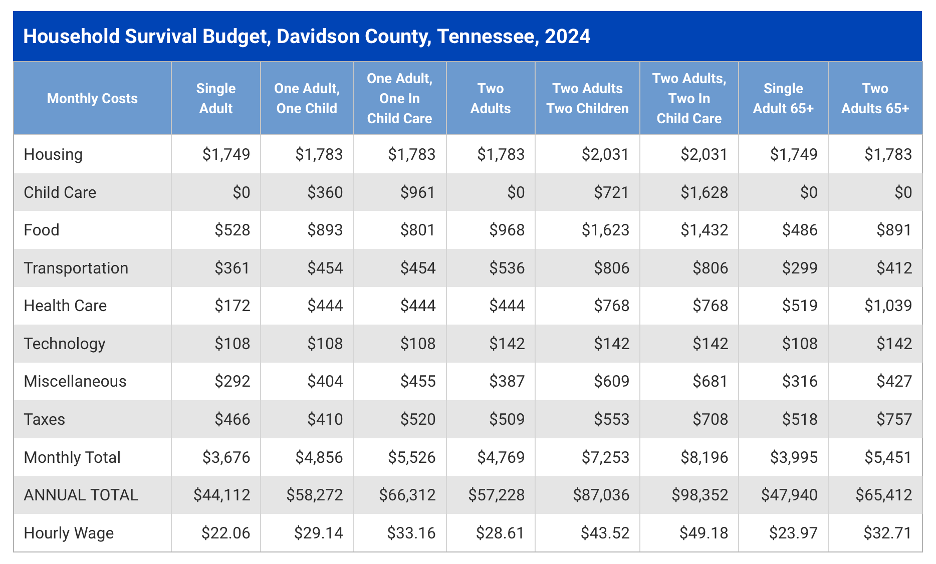
Notes: The budget for One Adult, One Child includes costs for one adult and a school-age child. The budget for One Adult, One in Child Care includes costs for an adult and an infant. The budget for Two Adults, Two in Child Care includes costs for two adults, one infant, and one preschooler. “Hourly Wage” shows the full-time wage needed to support each budget.
“While the data shows an overall decline in the number of ALICE families and some household costs, the rising cost of child care stands out as a clear and urgent challenge. In Davidson County, the cost of child care for one child increased by 53%, putting even more pressure on working families who are already struggling to make ends meet,” says Erin Akery, M.A., AFC®, Senior Manager, ALICE and Policy Relations, Financial Empowerment Center.
“When we underestimate how many households are struggling, we underestimate what it truly takes to build thriving communities,” said Erica Mitchell, UWGN President & CEO. “This means entire families and essential workers may be overlooked for support, left without the resources they need to stay healthy, achieve financial stability and reach their fullest potential. That’s a loss not just for ALICE, but for all of us.”
“ALICE families are especially vulnerable during natural disasters and times of economic uncertainty and yet often feel unseen or left behind,” said Stephanie Hoopes, Ph.D., National Director at United For ALICE. “By providing a name and a way to quantify these households, we’re equipping communities with the data to build solutions that offer better choices and real pathways to stability.”
More state and local data is available through the interactive dashboards on UnitedForALICE/Tennessee.